Hunter Loftis

I love building creative tools and intelligent systems.

The highlights of my career have been owning meaningful parts of Heroku's cloud platform, Adobe's Photoshop, and Reve AI's chart-topping image model.

Meanwhile, I always have an experiment or three going to tinker with new ideas.

I'm also a husband, a dad, and a founding engineer at Reve AI.

Current Fascinations

ML-augmented creative tools

Models unlock creative expression that would otherwise be impossible or infeasible. But which models, how are they steered, and where do they fit in the iterative loop of human creativity?

A tool that turns hand-painted pixel art into physically based 3D materials. It combines local models (depth, segmentation, upscaling) with traditional pixel manipulation to create albedo, height, emission, roughness, and metalness textures.

Multi-agent HCI

Bringing a mix of people and agents into productive collaboration is a whole new world of human-computer interaction. We're still learning how to split a system into mechanical and stochastic parts, steer emergent behavior without stifling intelligence, and balance correctness with responsiveness.
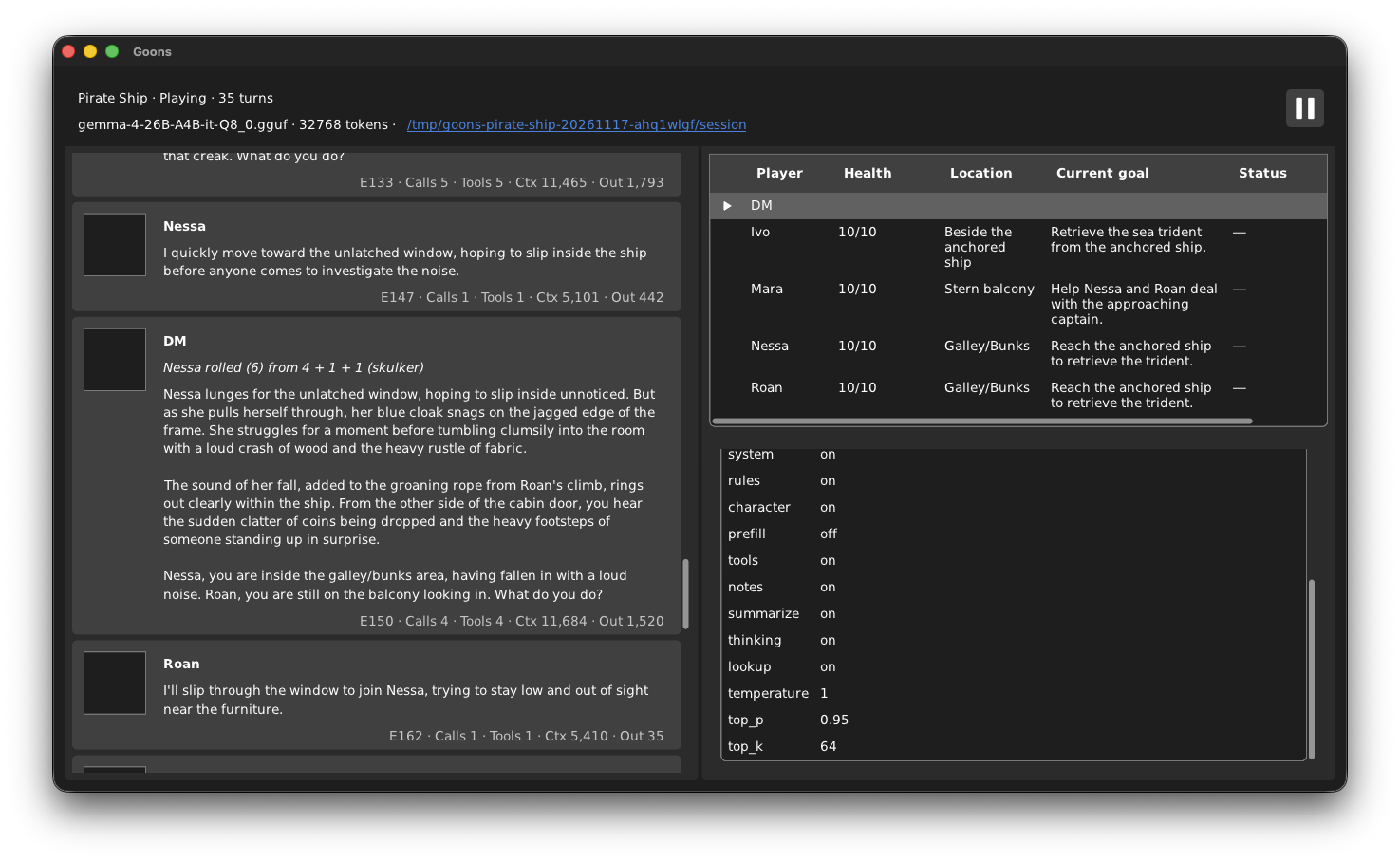
A cooperative role-playing session showing agent dialogue, player goals, and model settings.
Custom harness from a class I teach at UNCG: VES 400x, Demystifying AI. Five gemma4 agents autonomously role-play characters in a Tunnel Goons session. Model-driven strategy and role-play grounded by mechanical game state. Faster-than-human speed, running offline on a 64GB MBP.

Zig

Zig can embed llama.cpp and weights into a standalone, single binary that can be statically cross-compiled for Windows, Mac, and Linux. It trivially builds C dependencies, like SDL3 for universal I/O: graphics, audio, keyboards, windows, gamepads, etc. It's easy to read, easy to write, fast to build, fast to run, and comes with a nice stdlib. While I'm still a Zig novice, I'm having a lot of fun with it.

A retro fantasy FPS whose GPU compute renderer path traces every light, bounce, and reflection in real time. Walls are flat; sprites are billboards. PBR textures, normal maps, and parallax mapping create the illusion of detailed 3D surfaces on simple line segments.
Date Night Questions
A free tarot-inspired mobile card deck. My wife Amanda and I built this together. Tens of thousands of couples each month use it to make their dates more meaningful.
A Go Roguelike
Notes from building Jumpdrive, a sci-fi roguelike in Go. Procedural terrain, entity-component systems, and package boundaries. Written before Go had generics, which would have made some of this much simpler!
Painting with Light
How light interacts with materials, how random sampling turns into an image, and how to make it all run faster. Presented at GopherCon, GopherCon EU, and Scenic City Summit.
Making Sense of Multiplayer
What happens when dozens of players interact in real time over an unreliable network? I use a mobile JavaScript game to explore different ways to keep everyone in sync. Presented at Connect.Tech and RevolutionConf.
Stoppable
A small Node.js library for shutting down HTTP servers gracefully. A simple API for a surprisingly fiddly problem, installed millions of times each month.
PBR
A CPU path tracer written in Go, to learn Go. It simulates light bouncing through a scene, with physically-based materials, reflections, and refraction.
Space Snake
A little game I built for Ludum Dare 38 that placed third in graphics.
Renamed Types in Go
A small change in how data is represented can make the code that uses it much clearer.
Node.js on Heroku
I was responsible for Heroku's Node.js platform during years of explosive growth. One of the things I learned from that experience is the value, and process, of creating and maintaining world-class documentation.
Throng
A multiprocess worker-manager for clustered Node.js services, installed millions of times each month.
We Will All Be Game Developers
This March 2015 presentation is about borrowing gamedev techniques like simulation loops and real-time distributed state for web projects. Presented at JSConf EU, Nodevember, ForwardJS, and ConvergeSE.
Beyond Toys: Deploying a production node app to the cloud
An early talk about getting Node.js apps into production. Applying the twelve-factor approach to configuration, processes, logs, and deployment so the app can survive outside your laptop. Presented at the NYC Node.js Meetup in 2012. I later ended up responsible for 12factor.net during my time at Heroku.